Learn About OHP
The longer answer. Where this organization came from, how a mission actually works, who is accountable for it, and what is still pending — including the things we cannot yet tell you.
What OHP does
Oceans Humanity Project brings volunteer medical care by sea to underserved coastal communities of the Caribbean and the Americas. The model puts physicians, dentists, nurses, medications and supplies aboard one vessel — Mercy — and takes them to communities that are difficult to reach with medical personnel and supplies overland.
The reasoning is geographic rather than ideological. A community can be a short distance from a city and still be effectively cut off from it — by road conditions, terrain, water, or the simple economics of moving a clinical team and a pharmacy inland. A vessel changes that arithmetic. It carries the clinic, the supplies and the team together, and it can reach a coastline directly.
The bylaws passed by the Board of Trustees on 29 June 2026 state the purpose of the corporation in one sentence. It is the authoritative statement of what this organization exists to do:
to improve access to healthcare and humanitarian assistance for underserved coastal and island communities through maritime-based medical outreach and related humanitarian operations
Oceans Humanity Project is an independent, nonsectarian organization. Care is offered on the basis of need, and OHP works with whatever local organizations are best placed to help in a given community.
A proven mission. A new organization.
OHP has an unusual credibility position, and it is better to state it than to let a visitor discover it. The organization is new. The work is not.
For more than a decade, Mercy supported humanitarian medical outreach throughout the Caribbean and coastal South America. Volunteer physicians, nurses and maritime professionals lived and worked aboard while partnering with local organizations to provide care in underserved communities. That work — the sailings, the clinical teams, the patients treated — was carried out under GPA Globalization Ministries.
Over time the sponsoring ministry reassessed its long-term strategy. Many of the communities it had begun serving lay well inland, and it concluded that its future work could be carried out more effectively through permanent land-based operations. It redirected its resources away from maritime missions. That reflected an evolution in that organization's strategy — not any shortcoming of Mercy or of the vessel as a humanitarian platform.
Oceans Humanity Project was formed to carry the maritime mission forward under a different model: focused on coastal and island communities where access by water is the decisive advantage, with the vessel itself as the delivery platform rather than as housing for teams traveling inland. Where the predecessor's center of gravity moved inland, OHP's stays on the coastline.
Every mission result, patient count and outcome described anywhere on this site was achieved under GPA Globalization Ministries. Oceans Humanity Project is a separate, newly formed organization carrying that maritime medical mission forward. OHP does not claim to have performed work that predates its own existence.
We take that distinction seriously enough to enforce it in our own copy. Where you see a figure or a past result on this site, it belongs to the predecessor program and will be labeled that way. Where you see a description of what OHP will do, it is a statement of intent by a new organization.
Needed from OHP: the mission record from GPA Globalization Ministries — missions completed, countries served, patients treated, volunteers deployed, procedures performed — with the period the figures cover and confirmation of who verified them. Also the formal relationship between GPA and OHP (successor, affiliate, independent), and whether any GPA personnel other than Captain Hill carry over. No numbers appear on this site until OHP supplies them.
How a mission works
The model is deliberately simple, because complexity is expensive at sea.
1. Sail
The vessel departs with supplies, equipment and crew aboard, on a route planned around communities that have asked for care and countries that have authorized it.
2. Arrive
The vessel reaches a coastal community, arriving lawfully and by arrangement rather than unannounced.
3. Medical teams join
Volunteer clinicians — physicians, dentists, nurses and support staff — join the mission, credentialed and authorized in advance.
4. Care is delivered
The team sets up ashore and sees patients, working within the medications, equipment and scope of practice the mission carries and is permitted to provide.
5. Move to the next community
The vessel transits onward, and the pattern repeats along the coast.
What this model does well is reach. What it cannot do is replace a health system: a mission is episodic care, and its lasting value depends heavily on the in-country relationships that let patients be referred onward. That is why partnerships with organizations already working in these communities matter as much as the vessel does.
Mercy
Mercy is the vessel the mission is built around, and she is also the clearest way to explain it. Coastal communities can be geographically close yet difficult to reach with medical personnel and supplies. A vessel provides a mobile base for bringing care directly to them — carrying the team, the pharmacy and the equipment in one movement, and repeating it along a coastline.
She is not a theoretical platform. For more than a decade she carried volunteer medical teams throughout the Caribbean and coastal South America under GPA Globalization Ministries, which is why OHP's model can be described from experience rather than from a plan.
Oceans Humanity Project does not yet own Mercy. Her purchase is under way, and OHP has access to the vessel while it completes. OHP was formed to carry her service forward as a humanitarian medical platform, and completing her purchase is part of what this mission is raising support to do. Descriptions of missions aboard Mercy on this site refer to the model OHP is built to run.
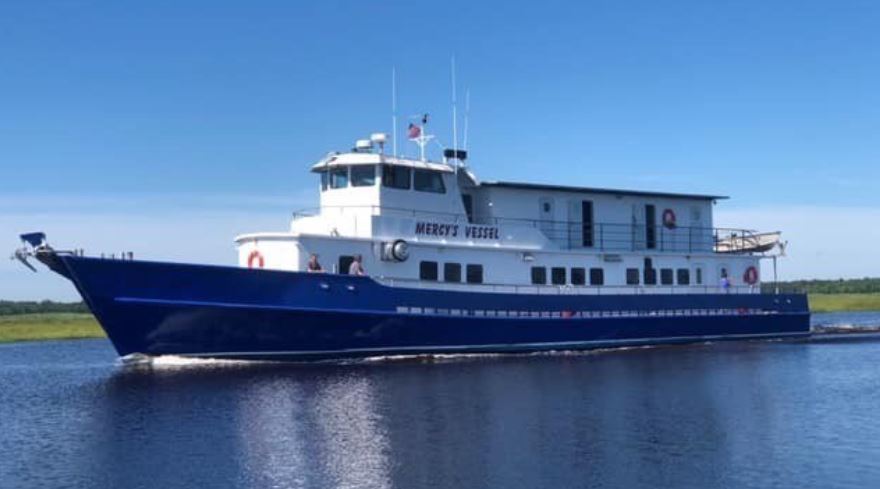
Needed: Mercy's specifications — length, flag and registry, class and survey status, berthing capacity, crew requirement, range and endurance, and a description of the clinical and storage spaces aboard, including any refrigeration for temperature-sensitive medicines. Also the acquisition cost, how that cost is treated separately from annual operating expense, the expected timeline to acquire and commission her, and her current condition and lay-up status.
Leadership
OHP is directed by a Board of Trustees and led by an Executive Director with responsibility for its maritime and mission operations. The people below are those OHP has named publicly.
Captain Darien Hill, MM — Executive Director

Captain Hill has more than three decades of professional maritime service, including over ten years in command of Mercy on humanitarian medical missions throughout the Caribbean and coastal South America — work carried out under GPA Globalization Ministries. He is a U.S. Coast Guard–licensed Master with an Oceans endorsement.
He has planned and directed complex international missions delivering volunteer physicians, nurses, medical supplies and healthcare services to underserved communities in logistically challenging environments. He served in the U.S. Navy as a Quartermaster and as a member of an Explosive Ordnance Disposal unit, and has also instructed navigation and maritime operations.
Board of Trustees
The board holds all corporate authority; OHP has no voting members. Trustees serve three-year terms, serve without compensation, and a majority must be independent at all times. The rules governing the board are summarized under Governance.
Dr. William M. Bowen — Chair
Emeritus Professor of Public Administration and Urban Policy, with a career focused on infrastructure, governance and resource allocation. He is an experienced offshore mariner and vessel owner.
Commander Xerxes Herrington, USN (Ret.) — Vice Chair
A retired submarine commander whose naval career included leadership of complex maritime operations and extensive work in international environments. He brings knowledge of maritime logistics, operational planning, safety and international coordination.
Ms. Cynthia Davison — Treasurer
A business accounting professional with extensive experience across accounts payable and receivable, payroll, employment tax reporting, sales and use tax reporting, and month-end bank reconciliation and reporting for multiple accounts, projects and properties. She has managed multiple databases, supervised procurement for equipment and for network and communications systems, and recruited, trained and supervised administrative staff.
Dr. Theodore T. Bowen, MD
A critical care neurologist with extensive experience caring for critically ill patients, directing multidisciplinary healthcare teams, and developing clinical policies for patient safety and quality of care. His expertise covers medical governance, risk management and evidence-based decision-making.
Dr. Bob Tramel, DDS
Needed: a biography for Dr. Tramel. Nothing is published here until OHP supplies it — the name and credential above are the whole of what OHP has provided.
Trustees sought
The board is actively seeking additional trustees. The bylaws provide for five to nine, and the areas where the board is looking to add depth are specific: medicine, dentistry, law, maritime operations, and nonprofit management. Trustees serve three-year terms without compensation, and the commitment is governance — setting standards, reviewing finances and holding the organization to them — rather than sailing.
If that describes you
Write to the board with a short note about your background and the area you would expect to contribute. Inquiries are treated in confidence.
Inquire about a trustee seatNeeded: the complete current trustee roster with the number of trustees now serving, each trustee's term start and expiry, which trustees the board has determined to be Independent Trustees under the bylaws, whether the Executive Director also holds a board seat, and photographs for the trustees other than Captain Hill.
Governance
Oceans Humanity Project is a Mississippi nonprofit corporation with its principal office in Mississippi, governed under bylaws passed by the Board of Trustees on 29 June 2026. What follows is a summary of the provisions a donor, volunteer or grantmaker would reasonably want to see. It is a summary, not the document.
No members; a governing board
OHP has no voting members. All corporate powers are exercised by, or under the authority of, the Board of Trustees. There is no membership body that can be appealed to over the board's head, and no ambiguity about where accountability sits.
Board composition and independence
- The board consists of five to nine trustees, with seven the target where practicable.
- A majority of trustees must be Independent Trustees at all times. An Independent Trustee is not an employee, is not compensated beyond reasonable reimbursement of expenses, and has no material financial interest in matters before the board.
- Independence is reviewed annually, not determined once at appointment.
- Trustees serve three-year terms.
- Trustees serve without compensation.
Conflicts of interest
A trustee with a conflict must disclose it fully, must abstain from all discussion and voting on the matter, and the minutes must record the disclosure, the recusal and the disposition. The recording requirement is the part that makes the rule enforceable after the fact, which is why it is stated here.
Policies the board maintains
The bylaws require the board to maintain, at minimum, a Conflict of Interest Policy, a Whistleblower Protection Policy, and a Document Retention and Destruction Policy.
Clinical and maritime authority are held separately
The board appoints a licensed physician as Medical Director, responsible for the standards governing credentialing, patient care, pharmaceuticals, infection control, medical documentation and quality assurance.
A Maritime Operations Director is responsible for the standards governing vessel maintenance, navigation, crew qualifications, safety drills, emergency preparedness, regulatory compliance and environmental stewardship.
These are two different kinds of judgement, and the bylaws keep them in two different pairs of hands — each qualified in its own field, each answerable to the board.
Nondiscrimination
OHP does not discriminate on the basis of race, color, national origin, sex, disability, age, religion, or any other protected status in carrying out its charitable activities, except where particular qualifications are legally or professionally required.
Use of assets
All assets are used solely to further the charitable mission. No trustee, officer, employee or volunteer may receive improper private benefit.
What is not published, and why
OHP operates under formal governance, maritime-safety, clinical and financial procedures. These cover how the vessel is operated and maintained, how clinical care is delivered and bounded, how volunteers are credentialed, and how money is controlled and recorded.
The operational detail of those procedures is not published, and that is a deliberate decision. Their existence and enforcement are what a donor, volunteer or partner needs in order to judge whether this is a serious organization. The contents — safety procedures, clinical protocols, financial controls — are working documents. Publishing them in full would serve no visitor and would create real operational and security risk. Governance documents are made available to institutional partners and grantmakers conducting diligence.
Needed: the names of the Medical Director and the Maritime Operations Director once appointed; the adoption date of each required policy; and confirmation of which governance documents OHP will publish openly versus provide on request during diligence.
501(c)(3) status
501(c)(3) status pending. Oceans Humanity Project is a new organization, and federal tax-exempt recognition under Section 501(c)(3) of the Internal Revenue Code is pending. It has not been granted. OHP does not represent that gifts are tax-deductible, and no visitor should assume that they are. Nothing on this site is tax or legal advice; anyone making a gift where tax treatment matters should consult their own advisor.
OHP's bylaws state that the corporation is organized and shall be operated exclusively for charitable purposes within the meaning of Section 501(c)(3) of the Internal Revenue Code. That is a statement of purpose in OHP's own governing document. It is not a determination by the Internal Revenue Service, it confers no exempt status, and it should not be read as one. Recognition remains pending.
This affects some supporters more than others. Grantmakers and donor-advised fund sponsors generally require a current determination letter before releasing funds, as do most corporate matching programs. Individuals giving without regard to tax treatment are not affected in the same way. Either way, we would rather you knew before you gave than after. Full detail on the Support the Mission page.
Needed: OHP's EIN, the date the exemption application was filed, the current stage of the application, and any state charitable-solicitation registrations together with the disclosure language those states require.
Financial model and reporting
What a year of operations costs
OHP projects approximately $500,000 per year to operate. That figure covers vessel operations — fuel, maintenance and crew — together with medical supplies and logistics, mission coordination and planning, and minimal administrative overhead. It is a planning projection for a full year of operations, not a result and not an audited figure.
Two structural facts make contributions go a long way against that number. Medical personnel volunteer their time, so the largest cost in most clinical settings is not a cost here. And medications are obtained at a fraction of retail cost. The effect is that a high proportion of each contribution converts into direct patient care rather than into salaries or markup.
Acquiring Mercy is a separate, one-time undertaking from this annual operating figure, and is described under Mercy.
What OHP measures
The organization tracks, and intends to report against:
- Patients treated
- Procedures performed
- Cost per patient served
- Follow-up care coordination
Cost per patient served is the one that connects the other three to the budget above, and it is the figure a funder should hold OHP to once missions are running.
Reporting
OHP's fiscal year is the calendar year, 1 January to 31 December. OHP has not yet completed a fiscal year of its own. There are therefore no financial statements, no annual report and no information returns to publish. Nothing is being withheld — those documents do not exist yet, and financial reporting begins with OHP's first fiscal year.
What will be published, as each first exists:
- Annual information returns, once OHP is required to file them and has done so
- Annual financial statements
- An annual report describing missions carried out and what they cost
- Mission reports covering communities served and care delivered
Until then the only figure on this site is the operating projection above, labeled as a projection. A projection presented as a result is the single most common way a new nonprofit misleads its supporters, and it is not a mistake this organization intends to make.
Needed: the first operating budget as approved by the board, broken down across the categories above; the date of OHP's first expected annual filing; whether financial statements will be audited, reviewed or compiled, and by whom; and confirmation of which financial documents will be published openly versus provided on request.
Safeguards and accountability
Delivering medical care abroad, from a vessel, to people with limited alternatives, concentrates a number of risks. OHP maintains procedures addressing each of the following, set under the authority of the Medical Director and the Maritime Operations Director the bylaws require (see Governance). As above, their existence is stated here; the operational detail is not published.
- Maritime safety — vessel operation, maintenance, crewing and emergency procedures.
- Clinical standards and scope of practice — clinicians work within their credentials and within what the mission is equipped and authorized to provide.
- Host-country authorization — care is delivered with the receiving country's permission. This constrains what a mission can offer, and it is meant to.
- Volunteer credentialing — primary-source verification of licensure, and background screening for volunteers in patient contact.
- Patient privacy and dignity — patients are owed the same standards they would be owed anywhere else.
- Consent for photography — informed and freely given, with no suggestion that care depends on agreeing to be photographed.
- Safeguarding of children and vulnerable adults — a condition of participation for everyone aboard.
- Financial controls — authorization, segregation of duties, and recording of how funds and in-kind gifts are used.
Frequently asked questions
Is OHP the same organization as GPA Globalization Ministries?
No. They are separate organizations. The maritime medical missions that established this model were carried out under GPA Globalization Ministries; Oceans Humanity Project is a new organization formed to carry that mission forward. Any past result described on this site belongs to GPA.
What is OHP's relationship to Mercy?
Mercy is the vessel this mission is built around. She spent more than a decade carrying volunteer medical teams throughout the Caribbean and coastal South America under GPA Globalization Ministries. OHP does not yet own her: her purchase is under way, and OHP has access to the vessel while it completes. Finishing that purchase and putting her into service as OHP's mission platform is part of what OHP is raising support to do.
Is OHP a religious organization?
No. Oceans Humanity Project is an independent, nonsectarian organization. Its predecessor program operated under a ministry; OHP does not. Care is offered on the basis of need, and OHP does not discriminate on the basis of religion or any other protected status.
Are trustees paid?
No. Trustees serve without compensation and may be reimbursed only for reasonable expenses. A majority of the board must be independent at all times, and that independence is reviewed annually.
What does "501(c)(3) status pending" mean for my gift?
It means recognition has been applied for but not granted. OHP does not represent that gifts are tax-deductible, and you should not assume that they are. Please consult your own tax advisor, and see Support the Mission for the full statement.
Where does OHP work?
Underserved coastal communities of the Caribbean and the Americas. Specific destinations depend on invitation, host-country authorization and vessel routing.
Needed: the countries and communities OHP expects to serve first, and the schedule of planned missions, so this answer can be specific.
Can I volunteer if I am not a clinician?
Possibly. Missions need interpreters, logistics and supply people, licensed maritime crew, and records support alongside clinical staff. See Join a Mission.
How do I know my gift was used well?
At present you have OHP's governance, its procedures, the experience of the people leading it, and the record of the predecessor program — and not yet its own financial reporting, because it has none. That is an honest limitation of supporting a new organization. The measures and reporting set out under Financial model and reporting are what will close the gap.
Can I see OHP's operating procedures?
Not in full, and no organization of this kind publishes them. Governance documents are available to institutional partners and grantmakers conducting diligence — see Partner With Us.
How do I contact OHP?
Write to oceanshumanityproject@gmail.com. A member of the organization will respond.
Choose a door
If you have read this far, you are probably deciding between three things.
Support the Mission Join a Mission Partner With Us